Tuesday, September 12, 2017

13th September, 2017


Was there ever a time of simplicity?
I have borne witness to the tangled garden,
And the tangled web of the thrice-clouded sky,
And the tangled strings of a smogged pigeon wing,
And the tangling of a half-massacred mouse, fur gummed with stoat saliva, a heartbeat waiting to die.
And I have wanted to bend my knee and beg, "Release me from myself!"
But You are the same God whose nature is always to have mercy.
You have pared my prayer to resistlessness,
Only an upward eye and acquiescence;
Only,
Thy will be done.

Why did You strip me of all the other prayers?
There are tangles in me that are crying out for combing:
Why must You mute me when I beg for simplicity?
I want to bargain;
I want to suggest Your ways to You, to author Your ways for You;
I want to say, "Take away my tangles! Have mercy! Give me a comb!"
And I want it to be done.
But You are the same God whose nature is always to have mercy.
There is nothing I have asked for that You have not granted;
There is nothing You have granted that I haven't repented.
And so my prayer closes to a point,
One essential straggled heartbeat.
Only,
Thy will be done.

Was it necessary for me to be a fool, mind-maimed?
Could I not have had the wisdom to be good, the goodness to be wise?
Was it necessary for me to be a farce,
Tangled as a tumbleweed,
Craving with the pain of childbirth a prelapsarian simplicity?
I am knotted as a manrope.
I keep picking at myself futilely trying to pull myself undone, trying to unravel.
I want to beg for simplicity,
But You steel my tongue. 
It is only,
Thy will be done.

One day, if it is Your will, I will stop resisting.
I will let the tangles be.
I will bear witness to the fallen garden,
And understand that when You said You would have me perfect
You meant Your perfection, not mine.
I will bear witness to the tangles in my soul,
The knot that You have tied,
And know that 
You are the same God whose nature is always to have mercy.

And my will will be
Only,
Thy will be done.

Sunday, September 10, 2017

10th September, 2017


I have been thinking about Jack. Today, for the first time in months, I tuned my guitar and attempted to play some of the old songs. The callouses have worn to an unpracticed softness and my right hand has lost its stamina for much strumming, but the routines return without much coaxing. I should practice more. Before I fell ill, I had begun taking lessons; a guitar instructor would come to the shop after work on a Wednesday and we'd set up stools and music stands and play passages from Cohen. Then the sickness came. Sometimes I wonder at the sickness and how much destruction it has wrought. Almost a year of suspended animation; almost a year absent from myself--degenerate, microscopic, humbled to a pinprick, Ozymandias sawn short at the knees.

The last time I saw Jack he was sitting in his wonted corner of the coffee-shop with his guitar and his flamenco scores and his dreams of up-sticking to Spain to serenade the flounce-frocked senoritas. He always treated me as if I were visiting royalty (although this is not unusual in America: an English accent in the States is a near guarantee of getting one's puddles overlaid by cloaks). He would throw his arms meadow-wide, strain his eyes heavenward, intone beatific nothings in cassock-Latin, affect a gesture of thespianic supplication with one arm thrown back like a swan-wing and the other hooked under his waist, bowing a bow deep as the mid-Atlantic ridge, then he would take my hand and lay upon it a kiss which was the very definition of courtliness, and I would buy him coffee. Jack made his living odd-jobbing and music teaching and washing windows, but he couldn't bring himself to charge those who couldn't easily pay and so his income was half comprised of grateful sandwiches and indebted hugs, a fact which meant he was permanently penniless. He cycled everywhere even in the dead of winter, with two repurposed paint buckets on the handlebars to hold the soap supplies, and wore weeds just presentable enough to permit him to sit on the warm side of coffee-shop doors.

Jack had lived in a monastery before he wound up washing windows in Michigan. He was hobbit-high, with hair blanched as Dover-bluffs, teeth-numbers roughly comparable to those of the Graeae sisters, eyes pale as Spring puddles and just as watery, and skin softly manifold-folded as a closet full of towels. He was beautiful: Rembrandt should have immortalised him. It's not in my power to do so. 

Jack would regale me with anecdotes about the great composers and, leafing through notes and scores he'd brought the cafe, desperately trying to locate this or that quote, explain to me in an understated yet overpowering earnestness the importance of becoming a master. One must become a master, he said, as that is the only way to do justice to the music, and music is one with prayer, and prayer is one with Love. One must therefore become a master as it is the only way to do justice to Love. 
      I wish I could do honour to Jack. I should try. I haven't the necessary stuffs to become a master, but I can at least work to approach the works and deeds of my hands with the reverence of prayer.

I remember Jack sitting opposite me at a wooden table, demonstrating a point about Rachmaninov's fingers. "Strong enough to break glass," he said.

The last time I saw Jack--that last time in the corner of the coffee shop on a winter evening where he sat playing Flamenco pieces and improvising ditties about myself and Tom, a college lad from South Wales who sat at his other side--I played for him. I never play in public; my fingers tense and jitter too much to allow it; but that evening I was able to play. I played "Look Over Your Shoulder," and when I was done Jack turned to me and said, beaming, "That's the 'Ethics of Elfland,' isn't it?" He knew! I could have cried. I should have hugged him.

We sat and talked and played and laughed for upwards of three hours that last evening, Jack and Tom and I. It was well I did not know it would be the last. I cannot conceive of a finer final memory. Jack died, suddenly, of a heart attack, two weeks later. I returned to England the following Spring.

I still imagine Jack is with me even now. Now and then I imagine this. Not in any material sense; only as a warm, benedictory presence, a faraway face re-presented to affect dramatic bows, and rumour-monger about Dvorak, and perfect his Flamenco pieces for the sake of the Spanish senoritas in the flounced-frocks and for the sake of prayer and of Love.

Saturday, September 9, 2017

9th September, 2017

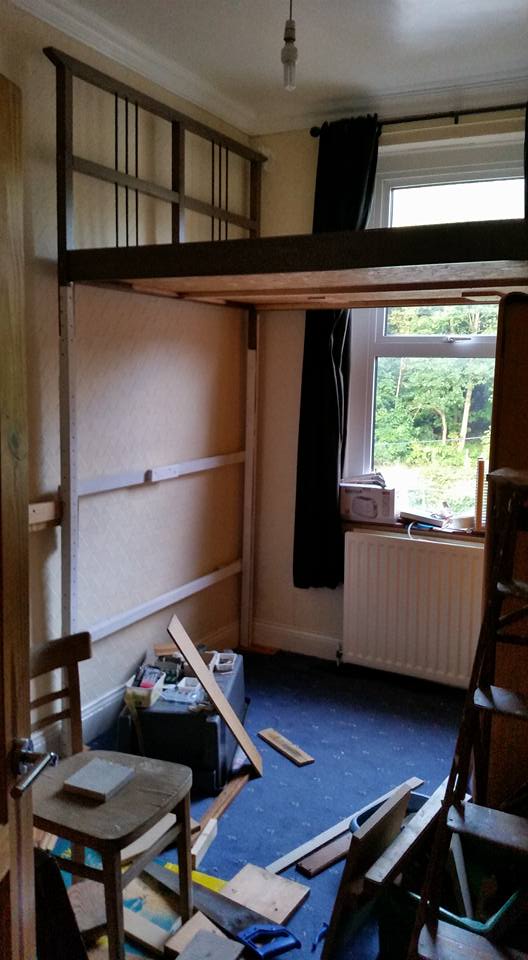
One of my father's many inventions:
The high-altitude bed, for when one wants one's dreams to be closer to heaven.


On being charmed.

I have been feeling achingly low of late. Now and then it is right and proper to feel so; now and then it is the right and proper response to the world. Aches have the capacity to put us in the right relation with the world. Aches also remind us that we are not automata, and it is important to be reminded of this every so often, particularly when there are so many voices declaiming the contrary.

Upon returning from work this evening, the aching got up again like an abscess in a shark's tooth. It is very tempting to simply sob and sob and degenerate and feel very poetically and nobly sorry for oneself when one has sharks' teeth with abscesses upon them.  The degree of pain always seems to justify the melodrama: to the right personality, a mislaid pencil could justify throwing oneself off the Ponte Vecchio. Alas, I have somewhat misused an adjective: "O Dio, vorrei morir!" I fear I may be the right sort of personality.

In a bold attempt to disprove I was the right sort of personality, and to unleague myself from Tosti and Puccini, I pulled my head out of the stage-prop basket of my hands, dabbed the tears sensibly away on the pleats of my skirt (for what are the voluminous swathes of fabric on women's skirts for if not to serve as handkerchiefs?), took Aristotle off his neglected column, and set to rereading, for what must be by now the fourteenth or fifteenth time, the beginning of the Metaphysics. I'm so voluminously ignorant. My ignorance rivals my skirts. This is a sorry state of affairs, and it seems wasteful to spend my hours a-weeping when I could be making at least a little dent in my denseness. I missed out on a classical education. I known't a lick of Latin, and not even the chastest cheek-peck of Greek. I haven't a hope of catching up with Western Civilization's bullet-train of thought, but I may perhaps at least walk a little faster than I do. It's worth a try.

So there I was, raw-eyed but determined, rereading the first paragraph of the Metaphysics for what must be by now the fortieth or fiftieth time, when who should come bounding up the stairs, looking very pleased with himself indeed, but my father, calling out as he ascended praises for my goodness as a daughter as I'd brought him home a bagful of tails. Then he turned to demonstrate the swish of a twelve-foot long, rather distinguished, plastic eco-packaging tail comprised of materials I'd saved for recycling. He walked around the attic room, like a gentlemanly tyrannosaurus, dragging the plastic behind him, and as he walked the cat followed, at once confused and intrigued by this new modification to her owner's anatomy. Then he let me know dinner was ready and headed back downstairs as bouncily as he'd ascended, the cat pouncing eagerly in pursuit.

How can one stay melancholy in the face of silliness like that? My father used to be a psychiatrist, but his methods of cheering me remain those of a father. When I was low as a child he used to place bags of onions on his head to make me giggle. I couldn't help it. No matter how miserable I was, something about the sight of onions in their string-sack on his head just couldn't be borne straight faced. Now, as an adult when I am blue he sticks into his ears and nose, a la Blackadder feigning get-out-of-the-push lunacy, the compostable packing-peanuts I rescue from work (I rescue them in order that he might dissolve them in buckets in the yard, for my father is the most avid recycler that ever there was). Or he does what he calls his "Trump Jump" (this is a sort of ungainly cheer-leading routine involving a fit of hoe-down-esque leaping, while requesting, at every bounce, a letter of Trump's name). And even now, as an adult, I cannot help but laugh. The laughing may not last long; the melancholies may be more severe these days and the mitigations more fleeting, but still, for at least a few seconds, for a snapshot of reprieve, I giggle as I did when I was hip-high.

So. There is pain, but there is also Aristotle and my father and a cat pouncing on a twelve-foot plastic tail. I need to remember this. It is still a charmed life.

Friday, September 8, 2017

8th September, 2017


When water gets caught in habitual whirlpools,
dig a way out through the bottom 
to the ocean. There is a secret medicine 
given only to those who hurt so hard
they can't hope.

The hopers would feel slighted if they knew.
-Rumi-

What does that secret medicine look like? When do they give it to you? And why did they not give it to all those who took their lives? Why did they hold off on giving the secret medicine to them?

I don't mean to be Job. I want to say only, graciously, lovingly, "Thy will be done," but I need Your help. I need You to hold me. I need You to let me feel You. I need the secret medicine. 
 

Sunday, August 13, 2017

13th August, 2017

St. Mark 

"I believe; help my unbelief!" Mark 9.24

Palm Sunday's reed cross holds pinned to my wall beside the watercolour aviary and the jar of cut flowers (peach roses and yellow carnations today, replacing last fortnight's coronet of sunflowers). "Carry your cross." These are the words with which one receives one's reeds. "Carry your cross, Sarah." I had been ill all winter; I had been away from church all winter; my baptism had fallen through; I was as the boy with the spirit that from childhood had "cast him into the fire and into the water, to destroy him," the boy whom the disciples could not heal, the boy who could only be restored through his father's cry, "I believe; help my unbelief!" Palm Sunday was my first day back at the church. I was handed my reed, and told "carry your cross." I took the cross home and pinned it beneath the moorhen, and I shall not take it down until I receive another next year. I shall carry my cross.


"Love only knoweth whence it came
and comprehendeth love."
J. G. Whittier

John Greenleaf Whittier

The Gradual Hymn today was Whittier's "Immortal Love." We are rather tuneless at Holy Cross, on account of most of us being over ninety and partly deaf. I haven't that excuse. I think I really ought take singing lessons and see if my tunelessness can be repaired. If I could sing better, I could sing at a higher volume, and then the vicar wouldn't be left doing all the work. The vicar has a resplendent singing voice; there is no finer moment than when, during the second to last verse of the recessional hymn (and it is always the second to last verse), he proceeds down the aisle, his baritone causing even the candles in the corners to quake, and as he passes, for one sublime instant, every tongue in the church is transformed, and we become angelic choirs not tone-deaf nonagenarians.

One by one all of these tongues will fall silent, and then it shall just be me. I should learn to sing. Even if I am the last voice in an emptied edifice, even if it is only I and the dust motes, and the lonely spears of light that pierce the hands of stained glass saints, even if it is only this, I should learn to sing. I should learn to sing for all that was, in remembrance and reverence of all that was, for every soul that brought his yearnings to the pew, her aching to the altar, his penitence to the prayer cushion, her love to the altar. I should learn to sing for all who suffered, and all who rejoiced, and all who cried out, "I believe; help my unbelief."

The last congregant may pass, and there may be no other to replace him, and the churches may fall silent, and the stones fail, and the stained glass saints bleach to a blankness, and even the dust motes return to dust, but Love shall not perish. There is no end to Love. My singing shall not be a threnody. I believe. Help my unbelief.


Images: 
St. Mark: By Jean Bourdichon - Bibliothèque nationale de France, lien/link ici/here, Public Domain, https://commons.wikimedia.org/w/index.php?curid=24527937
Whittier: By BPL - John Greenleaf Whittier, Public Domain, https://commons.wikimedia.org/w/index.php?curid=9722792


Tuesday, August 8, 2017

8th August, 2017


It would be conceit and folly to attempt a counterattack on a philosophical movement when one's exposure thereto/knowledge thereof consists of little more than one article in one popular philosophy magazine. As luck would have it, I am both egotist and eejit, and thus just the woman for the job. Hurrah! And...Onward:

Panpsychism: the belief that pans have consciousness. (Also the belief that colanders, cheese-graters, paring knives, and salt-cellars have consciousness. And salad bowls. And tapas dishes. And the grains of rice you put in the salt cellars to keep the crystals from congealing like Lot's wife. And everything else.) 

Before laying into the demerits of panpsychism, I suppose it would only be sporting to say a thing or two about its, well, its non-demerits. Spoonful of sugar and all that, even if the sugar isn't quite sweet enough to merit the unprefixed affirmative. 
  • Panpsychism isn't physicalism. That's something. The panpsychist doesn't reduce everything to physical entities and processes. So your average panpsychist is one-up on Empedocles and Anaximenes and...let me see...Hippasus of Metapontum. The panpsychist's world isn't all a confluence of Earth, Wind, and Fire (no disrespect to Thales and his water-water-everywhere monism; it just doesn't jive with Mr Maurice White's horoscope).
  • Panpsychism recognises that something-coming-from-nothing is a hitch in the ontological giddy-up. The notion that consciousness can arise out of non-consciousness is tricksy and rightly deserves more consideration than physicalists have afforded it.
  • Panpsychists likewise acknowledge that entities are more than what they do. A pan is not simply a bundle of behaviours "brought about by mass, spin, charge, etc." There must be "more to [a pan] than what it does; and according to panpsychism, mass, spin, charge, etc, are, in their intrinsic nature, forms of consciousness" (Goff).
  • Panpsychism adds quaint heft to one's notion that one's potted cactus is genuinely, subjectively happier on the left side of the mantelpiece than on the right side. Come on, admit it: you know full well your cactus wants to be by the photo of Great Aunt Clara and the misshapen pencil-pot you paid £50 too much for at a Cotswold pottery kiln.
Grand. Now for the quibbles:

Who needs panpsychism when you've got idealism?

Goff argues that "common sense intuition" must prevent us from sweeping consciousness under a singularly physicalist carpet, but surely that same "common sense intuition" should shield us from sweeping matter under a singularly mental one. Naturally, the panpsychist will protest that he hasn't swept the carpet under the carpet, that he never does any sweeping, that he doesn't even own a broom (in which case you can get him on charges of intellectual slobbery). The panpsychist is going to argue that he has, on the contrary, tread the middle path and reconciled the Scylla of substance-dualism with the Charybdis of physicalism. But, really, methinks the panpsychist does protest too much. For if one is going to redefine all "mass, spin, charge, etc" as "forms of consciousness", one really hasn't done much more than Anaxagoras, who, as Aristotle tells it, "avails himself of Mind as an artificial device for producing order, and drags it in whenever he is at a loss to explain some necessary result" (Metaphysics I.IV.5). Anaxagoras was less philosophically crude than the aforementioned Hippopotamus of Megapondus, granted, but that's not exactly an achievement you'd want to frame and put up on the wall: "I hereby certify that Mr. Pan Psychist is less primitive than a pachyderm".

I think it in my fingers, I think it in my bones

If all the world is busy ruminating, right down to one's individual electrons and subatomic charges, does that mean one's body really does have a mind of its own? Does my stomach think different thoughts than I do? Do my digestive fluids likewise have a separate subjective experience to my stomach (do my digestive fluids, ahem, digest)? And do the enzymes therein have a different experience yet again to said fluids? That would give a whole new pith to Melville's "Hell is an idea born of an undigested apple dumpling". 

There is something tantalising about the prospect of my atoms being philosophically at odds with myself. It's a charming image; I'm tempted to let it go unquestioned if only to allow myself the pleasure of debating with my knees. Yet, sigh, I can't shake the problem of pluralities. It's one thing to say an electron has consciousness, but what of two electrons together? Do the duo have a combined consciousness independent from the individual consciousnesses of the electrons which comprise them? Or are the two consciousnesses blended into one single superconsciousness? If that's the case, though, where does the blending end? At a universal consciousness that subsumes all things? Then how is it I feel my subjective experience to be individual and limited? Do individual elements go on having individual subjective experiences while the larger matrices thereof have larger, more complicated ones? What then determines which groups of individual elements will give rise to a new, more expansive consciousness? 
      The physicalist can get away, more or less, with a physical monism by maintaining that a pan isn't really a pan at all, but simply a bunch of fundamentally identical bits-and-pieces (subatomic energy packets or whatnot) distributed in certain arrangements in space and time. The physicalist's premises are flawed as your average Greek Hero, no doubt, but there is some coherence in his argument's form. The panpsychist hasn't even that advantage. For the panpsychist, as best I can fathom him, would seem to want to say that a pan has its own consciousness, and that said pan's consciousness is subjectively different from the consciousness of the atoms that comprise it. Yet this leaves the mystery of how the pan's consciousness arose as resolute and inscrutable as if its consciousness arose out of nothing, for the pan's consciousness is not, in this model, simply an illusion brought about by indivisible bits-and-pieces of consciousness hanging out together in the same spatio-temporal arena (as the pan was in the physicalist reduction). Even if the panpsychist was content to say that the pan's consciousness was an illusion, and was reducible to subatomic consciousness-packets (or something like that), he's going to run up against the problem of how those consciousness-packets produce the illusion of pan-consciousness. 

I know you are a reductionist, you said you are a reductionist, but what am I?

Panpsychists do not simply declare animal and human consciousness a sacred mystery which must have arrived by magic. Instead, they try to explain animal and human consciousness in terms of more basic forms of consciousness: the consciousness of basic material entities, such as quarks and electrons. It is true that consciousness itself is not explained in terms of anything more fundamental: the basic consciousness of basic physical entities is a fundamental postulate of the theory. But there is no reason to think that science must always follow the most reductionist path. (Goff)

Let's untangle that, shall we? 

  1. Animal and human consciousness are not sacred nor the product of magic. Jolly good. Nice to see religion (the sacred) and superstition (magic) being leagued together as per usual. Sign of the times, I guess: it's a lonely day in the Apologetics aisle if I'm not rubbing shoulders with a Wiccan; Crowley and Kierkegaard have never been closer bedfellows.
  2. Consciousness is to be explained by the basic consciousness of basic material entities. Lordy. Okay, so I assume basic here means, what, smallest? Least complicated? The most reduced? The most basic material entities Goff mentions are, after all, the poster-children of material reductionism (namely, quarks and electrons). Thus, consciousness is to be explained, presumably, by its most reduced form as manifested in its most reduced material counterparts.
  3. You can't reduce basic consciousness to anything more fundamental than basic consciousness. Well, quite, otherwise presumably it wouldn't be "basic" consciousness. Tautology taken on board. No infinite-regress reductios allowed.
  4. Out of left-field comment on science being non-beholden to reductionism, a comment which, by its placement, is naughtily positioning itself as a conclusion, despite actually being a non-sequitur. Goff describes panpsychism in reductionist terms, then says "not all science needs to be about reduction, folks." One might as well say "all omelettes require breaking eggs; but one doesn't have to break eggs to make a nutritious breakfast." Both statements ("omelettes require breaking eggs" and "nutritious breakfasts don't") might well be true; both might have subject-matter in common; but the one doesn't follow from the other, and to make it seem as if it did would be intellectual chicanery. So, tsk-tsk Goffum. Tricksy habitses.  
But, enough for now. I'm off to the store to buy me some thinking milk.

Panbrainism.

Monday, August 7, 2017

7th August, 2017


I do not ordinarily keep to-do lists outside of work. At work, after opening shop according to the usual routine, the first order of the day is always the to-do list which I indelicately scrawl in a series of smudgy bullet-points in a notebook that is really too pretty to deserve such ill-treatment (not that ugliness pardons ill-treatment; pity the fairy-tale dupe who fails to treat the snaggle-toothed crone as respectfully as the inevitable Venus she conceals). At work, the to-do list is a necessary corrective to my otherwise day-dreamy proclivities; without it I would run the risk of, well, of being as I am when I am not at work.
          To order my non-work time by a to-do list, on the other hand, would seem like a category error. At work it is necessary for me to be a machine to a certain extent (albeit one overseen by a stridently human soul, an Anthropos-ex-Machina as it were). At work I must be the instrument by which certain things get done; away from work, I must be anything but a machine. Away from work, my fullest attention must be on developing my humanity, my soul, and while this development may (indeed, probably always does) take the form of particular activities, to think of those activities as activities (i.e. as things “to do”) would be to turn soul-development into a variety of self-improvement seminar, something that involved completing a certain number of assignments to a certain standard before being handed one’s certificate and going on one’s way to pursue other activities. Perish the thought!

Yet today, a non-work day, I have broken my rule and have written a to-do list. I excuse myself in part because my primary reason for writing said list was to ensure I didn’t end up being a bad friend through forgetfulness. I am notoriously hopeless at maintaining punctual communication with the people I love, in no small part because I feel those people deserve more than boilerplate fripperies on every occasion, no matter how trifling, and so I can’t reply to even the simplest text message without at least fifteen minutes' pause to consider the most considerate response (despite the fact that the most considerate response is often the unconsidered, immediate one). On account of this lack of punctuality, I end up with a backlog of messages on one medium or another, and then I forget to reply at all. Thus today’s list. And yet I failed to stop there. Although it is true that most of today's list consists of “text so-and-so” and “call such-and-such”, other items have ended up slipping in also: “Vacuum room”, “Finish Typography Book”, “Read something by Chesterton”, “Write blog post”.  I suppose, in my present state of mental wellness, I have been feeling strong enough to overcome the lure of completion-for-completion’s-sake (or, more accurately, completion-for-check-mark’s-sake). Herein lies hubris. Not unamalgamated hubris, but I admit I did end up approaching Chesterton as a task to be accomplished, and not, as he deserved, as a friend to be enjoyed or a teacher to be minded. (Of course, it is impossible to treat Chesterton entirely as a means to a check mark; there will always be points at which he breaks through one's utilitarian trance and biffs one, as one quite rightly deserves, on the metaphorical nose).


It is now late afternoon. This was not the post I intended to write. That post was on the article on Panpsychism, the reading of which also finagled its way onto the to-do list. That post shall have to wait (or pone? as in postpone?). The order of the afternoon is to walk. This too is on the list, but it is also on the heart (and, hummty-tum, the sole), and so can’t be wounded by a bullet-point.  

Thursday, July 14, 2016

14th July, 2016


"All or Nothing is my call;
should you by the roadside fall,
then your life's been thrown away.
No concession to distress,
no reprieve for trespasses; --
and should life not bear the strain,
you must gladly die, no less."

"O, but I had failed to see
All or Nothing it must be.
Compromise's road I blundered; --
but today God spoke to me.
At this moment, o'er this house,
doom's shrill trumpet-blast has thundered; --
and I listened, tremulous, --
crushed, like David facing Nathan, --
battered, anguished-tossed, dismayed --;
all my doubts have now been laid.
The spirit of compromise is Satan!"

--Ibsen, Brand--

"All or Nothing." This is Brand's cry. And no-one could be more earnest in practicing what they preach than Brand. He gives up comfort, home, wife, child, community, and life itself in his ardor to give all. Yet he ends the play, in the closing act, succumbing beneath an avalanche, calling upwards to heaven, "Tell me, God, in death's abyss; -- / is no fleck of hoped-for bliss / earned by man's will, quantum satis --?" And the final line reads "A Voice (calls through the thunderous din): He is deus caritatis!" He is a God of Love. The stage-prompt is so trickily ambiguous. Whose voice is it? Is it the voice of God? Is it that of Brand's companion Gerd? Is it the voice of Brand himself? One way or the other, "He is a God of Love" is Ibsen's answer to the question, "how much is enough?" "He is a God of Love" is Ibsen's answer to Brand's overriding question of what it means to give all.
     What sort of an answer is "He is a God of Love"? An answer that sent me grinning altitudinous, cheeks surging upwards to the temples in contentment. I closed the book, those disintegrating mid-century covers, stood up, turned to beam at A____, and absconded to the garden, to the Canadian March and the unthawed lake. Why did the answer make me so happy? Why was I so satisfied with it?
     I desire to give all. I, like Brand, feel I must live to the tune of "All or Nothing." I, like Brand, cannot content myself with compromise. And I do recognize that this is potentially a very dangerous way to be. It is the sort of personality out of which monomanias are born. It is to be in attitudinal league with Ahab and Hamlet. Yet I know no way of throwing off this aspect of myself, and, more significantly, I would not throw it off even if I got the chance. 
      So. I live with a powder keg within myself. Willfully I live so. Why? Why would anyone take the risk of such internal intensity? Why would anyone embrace a philosophy of all or nothing? I can only answer that I have found no way to disentangle the things I most desire from the philosophy of all or nothing. As soon as I try to logically unhitch the things I most desire from this philosophy, they lose their desirability. I stop desiring love as soon as I stop seeing it as something that deserves my all. I stop desiring truth as soon as I start supposing truth might not be, in its deepest sense, absolute. I stop desiring life when I start to think I owe it anything less than everything. And the moment I came to believe that God could be sufficiently honored in half-measures would be the moment I came to disbelieve in God. 
     Am I to be Brand, then? Am I to give up all that he gave up in order to fulfill my commitment to "all or nothing"? No. No. That cannot be it. I would not have smiled so merrily at the closing of the book if that had been the conclusion. The conclusion was not that "all or nothing" requires complete surrender of all the things that render life dear. The conclusion was the opposite. "He is a God of Love." That was the conclusion. Brand misinterpreted what it meant to give all. He supposed giving all was synonymous with giving up all. Yet, in giving up all, he gave up every manifestation of love. In giving up all, he self-avowedly made "no concession to distress" and "no reprieve for trespasses," and thereby acted contrary to compassion, to mercy, to all of the principle tenets of Love; he acted contrary, indeed, to the very wording of the Lord's prayer. 
      And what of myself? It is so difficult to unbiasedly scrutinize oneself. Yet I think I have myself fallen into Brand's same rut of misinterpreting "all or nothing." I have not thought deeply enough. I have not thought bravely enough. I have not trusted enough. I have said to myself "obey," forgetting that Love's injunction is not to "obey" in and of itself, but to obey those commandments in which one has Faith or concerning which one has understanding (granted, one may object that I am here expressing a personal and not an orthodox Faith/theology, but my Faith/theology is personal; any attempt on my part to swallow an orthodox Faith/theology that went against my personal Faith /theology would be a pretense, a nothingness). If one obeys an edict that does not strike one's thought and Faith as wholly in line with Love, one is not obeying Love, but some other master (most likely, in my case, fear). 
     Light burst upon me yesterday morning. Lightness did. With an intensity I had forgotten for sadly many months, possibly even years, I recalled how very dearly I loved my friends. Such lightness. A great weight, carried unbeknownst for such a long while, left on the mattress with the insomnia that attended it.  

Tuesday, February 16, 2016

17th February, 2016


“A few million years ago, the present site of the city of Chicago was buried under three kilometers of frost.” –Carl Sagan, Cosmos.

Buried under three kilometers of frost! Never escaping frost despite the Spring, despite the Summer! Lifeless, cold, a wasteland. Oh, world! How impermanent, how fragile everything is. All that I love-- the cracked calls of the cardinal and the redwing, the various jade-golds of Spring grass and Spring leaf, the perfect palate of a vital globe--all of it is so fleeting. If it were only the case that I would not remain, the thought would not be so heart-breaking; but to think that all of it must vapor?! To think that there will come an end to seasons?! To think that there will come an end to the Earth and its circling romance with the sun?! So hopelessly final!
     And I here, bound to the robins and the Spring grasses and the hum of a lawnmower, and an apple tree newly in leaf; bound in the sublimest and most delicate communion of a shared moment; suspended in the most tragic of all vessels, the inescapably doomed ship of a finite moment in time.

     I was alive with the robins, in the days when Michigan was mitten-shaped and was full of Spring grass. I was alive when stars glowed overhead in the night sky. I was alive when there was a solar system with the sun at its center, a sun that warmed the Earth and melted ice-cream in children’s hands. I was alive when there were colors, and fellow men, and a language to name things. I was alive when there was light. I was alive when there was matter. I was alive in the days of LOVE and of BEAUTY. I was alive when birds migrated and butterflies emerged from cocoons. I was alive when men smiled, and sang, and put their arms around one another in friendship, and cared deeply about one another. I was alive when the universe was expanding. I was alive when sunshine wrought freckles. I was alive to hear poetry. I lived in the days of the chickadee, and the ocean, and the hurricane. The tortoise was my companion, as was the mosquito and the whale. The world has never known days like the ones in which I was alive.

     We will all go. The robins, the rivers, the poetry, the stars. We all lived together, and though some of us will last longer than others, we will all go. Not a one of us will last. We are even now a living memory.

     Let me not forget the communal bonds of time, the kinship of a shared temporality. All that is, at this moment, is as a passenger on the same shipwreck-bound raft. Not a one of us will survive. We are, every one of us, brothers in tragedy. It is all so lovely and so…so…doomed. Like the beautiful consumptive in an old-fashioned novel whom we know, know from the first cough, must die. The story cannot let her live. Even Horatio and the angels must perish. But we were once in one another’s arms. The robins, and the Spring grasses, and the stars, and the men embracing the ones that they loved—we were once all of the same temporal piece. A shared experience. A shared memory. A moment in time. 

Wednesday, January 20, 2016

1/21/2016


Classical guitar. Skies lacquer black, slick black, lake black; polished. Or, perhaps not. Perhaps a fraying sailor-suit blue. Perhaps navy-grey and garlanded with smoke-orange about the horizon, like the eyes of a heterochromiac, like the fire that rings the heterochromiac's pupil before being doused by the sea-storm of the iris. Hot tea, decaffeinated and very milky.

"Consolation resides where we, having ventured out into all these dangerous experiments of individual living, at last [find ourselves] coming back, and swallowing our pride, and humbly acquiescing in a social order that is bigger than ourselves." -- Roger Scruton.

There is something that pulls us back, that rightly pulls us back to a place of community, to a place of humility, to a place where we divest the garments we donned to mark ourselves apart from our fellow man (whether these garments were donned originally for defense or attack, for fear's sake or for pride's, does not matter), and become part of a whole. The further I stray from humility, from the acknowledgement that I am not a piece-apart but rather a part-of-a-whole, the more troubled I become. I must remember this. How can I make myself remember?

The following from a journal kept five years back:

4-18-11

Do not conceive of yourself as in competition with the world, Sarah. You do not have to be so. Even when it all seems like a grand game of the prisoner's dilemma and everybody is defecting, don't ever defect yourself. Always cooperate. The most to be lost in cooperating is your life. In defecting you risk far greater losses, namely your very will to live. Hush the ego. Hush the voice that begs for distinction over your fellow man. That is a voice of fear, a voice born of the insecurities inherent in trying to compete with the world. You no longer need it. You are choosing to cooperate. It is the most liberating, joy-inspiring, happiness-inducing choice you could ever make. You are freeing yourself to rejoice in all that is around you, to add your voice to the universal ode to joy without having to worry about whether it is off-key or less sonorous than your neighbor's. You are not in competition with your neighbor and thereby are no longer in need of fear of him, or, to allay such fears, superiority over him. What is left? To love him. Love is what remains when you have stripped away the husk of competition. Love and all the inestimable joy that attends it. Do not fear cooperating though all else are defecting. It is the sure and solitary gateway to joy. My heart aches. I shall love. 

We learn lessons and then we lose them, and find them, and lose them again. We are continually having to humble ourselves at the feet of our past. And this takes so much pride-swallowing, for it is one thing to be ignorant of a lesson one has not learned, but quite another to remain ignorant of a lesson one has learned multiple times over. But swallow my pride I must. Provided I am not as I am meant to be, I shall vary even as the seasons do, and like as not be five-hundred different selves in the course of each year. It is only once we draw closer to who we are meant to be that we can draw closer to consistency; only then can we retain our lessons. Until such a point, we must learn the lessons again and again, and remind ourselves of them over and over to stave off the risk of forgetting, and practice their teachings in earnest, for this is the only way in which to draw closer to whom we are meant to be, to draw closer to whom we most truly are. 
      I have been reminded of this lesson this evening. Let me work with all my might not to forget it. 

Wednesday, December 30, 2015

30th December, 2015


      I cannot escape an epistemology of some kind. There is no such thing as true, Feyerabendian epistemological-anarchy available to me, or, I must suppose, to anyone. For the very reasoning that would allow one to accept the validity of the epistemological free-for-alls Feyerabend proposes is the very reasoning that betrays its own epistemological biases. We cannot dispense with our faith in, say, science, without putting our faith in an alternative system of knowledge that illuminates science as unreliable. For example, we may point out that science is, as Feyerabend puts it, "a complex medium containing surprising and unforeseen developments [that demand] complex procedures and [defy] analysis on the basis of rules which have been set up in advance and without regard to the ever-changing conditions of history," but to make this claim, we must put our faith in an epistemological framework that says that epistemological frameworks should not have rules that can be defied by unforeseen developments. 
       Let me try to put that more clearly. We may imagine an epistemological framework whereby 1+1=3. Every time we apply this framework to the empirical universe, the accuracy/validity of the framework is confirmed. This goes on for centuries, until one day we discover a Humean blip in our experience of things, whereby 1+1 doesn't equal 3. And perhaps we have many other epistemological frameworks that have also proven infallible throughout the ages, but are one day defied by the same empirical data that we had, back in the day, used to derive them. Objects start floating upwards in defiance of gravity. Dogs start giving birth to whales in defiance of genetics and biology. Events start happening randomly, with previously supposed effects chaotically preceding supposed causes. Apples are tasted before they are bought and bitten; trains arrive at their destinations before they leave their departure point; mothers fall pregnant before fathers ever make love to them. Rivers run with wine and tigers start growing on trees. If we allow these strange occurrences to overturn--or even simply to problematize--our epistemological frameworks, we do so because we put our faith in an epistemological framework that asserts: "if an epistemological framework asserts 1+1=3 and it is discovered 1+1 does not equal 3, that epistemological framework is flawed." 
     Overturn science, theology, philosophy, or any epistemological framework you please, you will not have overturned epistemological frameworks as a general category, nor will you have arrived at a state of epistemological anarchy. You will only have arrived at an epistemological framework that states, as a reliable fact, that any epistemological framework whose assertions prove unreliable aught not to be relied upon (or something of that general ilk). 
     So I cannot escape an epistemology of some kind. Is that an axiomatic statement for me? Possibly. And what does this amount to? What is the epistemological framework that persuades me that I cannot possibly escape from an epistemological framework, that the thinking process is necessarily bound up with an epistemological framework, and if one gets rid of the latter altogether, one gets rid of the former (the former as one knows it)? 
     Tautology and contradiction. I think that's it. I think, at base, those are my intellectual foundation stones. And what do tautology and contradiction amount to? Why do I judge the validity of all propositions on the basis that "1 equals 1" is truth/reality/fact/etc., while "1 does not equal 1" is false/unreal/non-factual/etc.? Why, despite all I can believe, can I not believe that A is not A? Why, despite all I can doubt, can I not doubt that A is A? 
     I'm not sure, other than to say that there is that in me that feels dissonance and agitation in the face of a contradiction, and is restless to overcome said contradiction (i.e. there is that in me that is restless to resolve the contradiction, and thereby render the contradiction a contradiction no more). (This is not to say that I cannot enjoy contradictions; it is only to say that I cannot directly cognize them without a feeling of mental agitation and a correspondent need to resolve/dissolve them). On the other hand, tautologies induce a sensation of harmony, ease, and rest within me. When I encounter a tautology, I experience a sense of cerebral satiation; I feel no need to overcome or somehow get beyond it. When someone asserts that an orange is an orange, I feel no mental agitation. On the contrary, I feel mentally at rest. When someone asserts, with all sincerity, that an orange is not an orange, I feel mentally agitated; my mind's rest is disturbed and it will do all it can to get itself to a place of mental rest again. Either my mind will try to find some way in which the contradiction can be dissolved (e.g. by showing that the asserter is using the one term "orange" to refer to two different entities or qualities), or my mind will turn its attention away from the contradiction and think about some other thing. Tautologies feel stable, eternal, unchangeable. Contradictions feel unstable, impermanent, mutable.
     But the point of these musings was not to discuss the nature of epistemological frameworks so much as to acknowledge my enthrallment in them, and to point to my inability to step outside of my own epistemological framework and assess my reasons for believing what I believe and thinking what I think from an unprejudiced, unblinkered perspective. I am as one who realizes she might be blind, but having no idea what sight means, really has no idea what blindness means. I cannot properly acknowledge my ignorance, as only one who has transcended ignorance can comprehend ignorance. Only the man who has experienced blindness and sight understands blindness. The man who has never seen does not really know what it means to be blind.
     Having never stepped outside of my own epistemological framework, I have never been in a position to adjudicate its validity, and I have no way of knowing whether is has any merit or not outside of its own, self-ascribed parameters. Even my supposition that I would need to step outside of my epistemological framework is a product of my epistemological framework, and possibly incorrect (or correct, or something else entirely).
      If there is no way of assessing the merit/accuracy/validity of one's own epistemological framework--if this is what one's epistemological framework inclines one to believe--all knowledge becomes a matter of faith, faith determined by feelings. My epistemological framework causes me to judge all on the basis of tautology and contradiction. And this is to say that I judge all on the basis of a feeling of mental dissonance/agitation and a feeling of mental harmony/rest. I call the agitated feeling falsehood (inaccuracy; non-reality; non-factuality; etc.), and the harmonious feeling truth (accuracy; reality; factuality; etc.). This is what it all boils down to. I cannot pretend to any more stable or transcendent or objective reasons for believing anything I believe than this. 
   And when I acknowledge this truth (i.e. this catalyst of a feeling of mental contentment/rest/harmony) about my epistemological framework, I realize the door is flung open with radiant wideness for me to accept Kierkegaardian, Cherstertonian, MacDonaldian, Trahernian Christian faith with every bit as much vigor as I accept mathematics, astrophysics, and the testimony of my five senses. Provided the propositions of Christian faith produce in me the same degree of mental harmony/rest as the propositions of those other jurors (mathematics, etc.), their validity  will be of a piece. For though I am not free to accept any proposition ever put forth, and cannot accept any that produce a sense of mental disharmony in me (e.g. the notion of an eternal hellfire in the traditional, Dantean sense), I am free to accept any proposition that produces a sense of mental harmony/rest (e.g. the idea of an omnipotent LOVE at the core of all things).

Monday, November 23, 2015

23rd November, 2015


What do the wordless write?

I want to write honesty. I want to write that which is not numbness or fear. And I would prefer to write that which is not vacillation. But I do not know if it is possible to write so without an inconsistency. Not yet. Not as I am. Not with my soul as it is; so other than I would have it be.

I am scared of the flux inside of me. The bursts of bravery that pull me out of the tarpits are good things, but my confidence fades a little with every repetition. The first time one is rescued, all hope and optimism is renewed. The second and the third time likewise. But let a person be rescued fifty times, and rather than feeling gratitude for their salvation, they are likely to experience only apprehension. The man who has escaped the lion's den once counts himself blessed. The man who has escaped the lion's den fifty times is more likely to deem himself cursed. It is hardly good luck to require rescue so many times. I lose faith in my resilience.

Sunday, May 31, 2015

31st May, 2015

"And it had been a source of keen pleasure when, below the delicate line of the violin-part, slender but robust, compact and commanding, he had suddenly become aware of the mass of the piano-part beginning to emerge in a sort of liquid rippling of sound, multiform but indivisible, smooth yet restless, like the deep blue tumult of the sea, silvered and charmed into a minor key by the moonlight."
 -- Proust, Swann's Way--

I have today again been consumed by the question of Art vs. Nature, and how the two concepts differ, and which holds greater sway in my affections. In my foregoing post, I noted that, after an imaginary conversation with a professor on this subject, I had come to doubt the hierarchy (my hierarchy) in which Nature presides as a Hyperion over the comparable satyr Art. About three quarters of the way around Buhl Lake, and a good half-hour into the phantasmal dialogue, I was forced to concede that Art was the conduit by which I arrived at my exalted opinion of Nature. I stand by that concession even now, a week hence. Yet today's thoughts have asked further concessions of me, this time by virtue of Vivaldi. I am now requested not merely to admit a preference for viewing Nature through the lens of Art, but further to admit that works of art may on occasion trump works of nature.

Let us consider the opening Allegro of Vivaldi's "La Primavera." We may, for the sake of this discussion, elide (or, at least, substantially abridge) mention of the ritornello, for though the ritornello sets out the concerto's seasonal theme, it suggests Spring rather as an abstraction than as an actuality. The ritornello does not directly mimic any specific Spring characteristic as do the piece's subsequent elements, but rather evokes a general Spring mood--a sense of something buoyantly magisterial, like a young prince stately cantering over greening meadows (assuming one may stately canter; possibly a canter precludes stateliness; the ritornello in the above-featured video attempts a canter and does diminish somewhat in stateliness thereby). In its generality and abstraction the ritornello in "La Primavera" does not compete with any specific aspect of Nature and thus does not raise the question of Nature vs. Art.

The first violin solo, however, does compete with Nature. This solo is one of those mathematically-errant solos that typify the Baroque, whereby the Ante-Nicene riddle of the trinity finds itself orchestrally reenacted, or, to put it more mundanely, the "solo" comprises three instruments. These three instruments each speak or sing to one another in that prettily interruptive and overlapping way that typifies woodland soundscapes. One would be hard-pressed to listen to this violin solo and not bring to mind birdsong. Yet the violin solo offers not an imitation of birdsong so much as a translation, a translation that grasps something Nature herself has failed to grasp. In "La Primavera," Vivaldi presents his listeners with a seeming Platonic form of birdsong, a form that reveals actual birdsong to be only an imperfect copy.

Could it be possible that I might prefer the birdsong of Vivaldi to the birdsong of Buhl Lake? No, no, I could not admit that. Paired side-by-side and out of context, I would, it is true, have to acknowledge the aesthetic superiority of the former, but actual birdsong does not exist independent of birds, and I would rather have my lakeside strolls bereft of Vivaldi's strains than bereft of Nature's. The same goes with the river-sounds and thunders that follow the latter returns of the ritornello. No river ever sounded so enchanting, nor so essentially river-like, as Vivaldi's stringed ripplings, yet beside an actual brook-bank I would rather have water. Zeus never conjured storms so striking as the Red Priest's, yet I would sooner retain the acoustics of Olympus at my window than trade them for the grander euphonics of Art.

I am not so very changed. I still persist, as a general rule, in loving Nature first and next to Nature Art. Yet I do now have to grant that, in some cases, if the Art is placed side-by-side with Nature, I am inclined to love Art the more. That is to say, if the formulation reads "Art, and next to Art, Nature"--then I, true to pseudo-tautological impulse, do now-and-then reverse my Landorian creed: when Art is next to (i.e. side-by-side with) Nature, I do now-and-then love Nature next to (i.e. after; less than) Art.

Monday, May 25, 2015

25th May, 2015


I have let myself be scatterbrained today. Indeed, I have let myself be so all days of late, and it will not do. This airiness of structure (this absence of structure) is time thrown to the zephyrs. I need to focus. Deliberate, careful, concentrational study, that's what is required. A program of paying attention. 

Seneca advises us to take one thought each day to consider deeply. Just one. One from all the thousands. Wise words. But the tragedy of wisdom is that it always operates so much more smoothly on paper than in practice. In practice it is impossible to know which thought one should concentrate on each day until the day and all its thought-production is through. And the thought that is one's darling in the morning is seldom the same as that which bewitches one in the afternoon, and neither of those comprise the cynosure of the night. 

This morning my chief candidate for thought-of-the-day had to do with the distinction between art and nature. I wanted to determine which of these parties reigned (or should reign) supreme, or whether both governed in coalition over man's aesthetic faculties. In the past I typically sided with Landor (Walter Savage) on this question and loved nature first "and next to nature art." Yet last semester a professor whose opinion I hold in high regard told me that, for him, nature must ever play second fiddle to art, and though this professor did not dilate upon his reasons for believing so, ever since that conversation I have found myself more uncertain of my nature/art hierarchy. Which brings me to my morning walk around Buhl Lake, whereupon, having been mesmerized for several minutes by the painted back of a fire-furred caterpillar on the pathway, I lapsed into a renewed imaginary dialogue with said professor, wherein I tried to win him round to my nature-championing point of view. Yet, much to my puzzlement given that I was both voices in the conversation and was thereby odds-on to succeed in my persuasions, it was not so much the professor that came round to my point of view as it was I that came round to his. I had engineered the ruse (in this imaginary conversation) of having the professor stop by some honeysuckle bush and read one of its leaves as if it were a poem (as if the leaf were the creation of a poet), thinking that this would apprise the professor of the superior complexity and beauty and compositional-perspicacity of nature. But my ruse backfired when the professor pointed out that, in the context of my experiment, it was precisely his familiarity with art that enabled him to recognize the splendors in the leaf in the first place. And dash it all, he was right. I had vowed nature was to art as Hyperion to a satyr, and yet without the satyr art my Hyperion looked set to become a mere mortal.

But these were morning thoughts and it is no longer morning and they no longer fit the hour.

Sunday, May 24, 2015

24th May, 2015


The above image is a still life by Henri Fantin-Latour, titled Still Life, dated 1866. I do not know that any artist before or after has ever come so close to capturing what it is to look upon the world, to really look upon the world, to look as men and women look. A photograph does not capture what it is to look upon the world, nor yet does photographic realism. The world does not greet the eye of man as it greets the lens of a camera; the world is not experienced as unamalgamated matter. Nor, on the other hand, do abstract, impressionistic, surrealistic or conceptual works approach what it is to look upon the world. The world is not experienced as unamalgamated mind. Fantin-Latour's great genius is to have looked at the world and, steering clear of the Scylla of materialism and the Charybdis of idealism, to have simply painted what he saw.

If Fantin-Latour had only been a little less successful, I would not so desire to push the tray further back upon the table. It makes me almost anxious to see it thus precariously arranged. 

Monday, June 2, 2014

June 2nd, 2014

What follows is a story written as a class assignment. The assignment instructions were to render Taniguchi's comic tale "A Blanket of Cherry Blossom" into prose. The images are a sample of Taniguchi's from the comic in question. The text, for what it's worth, is mine.

walking-man-2.jpg (1131×336)

A Blanket of Cherry Blossom

Part 1
            “La Petite Voleuse”—lower-case letters in an upper left corner. The film is French and therefore respectable, and my grip on the box is accordingly casual. Naked flesh running the length of the right corners—shapely arms that extend the length of shapely legs and shimmy delicate live-heels into indelicate high-heels. The film is French and therefore risqué, and my grip on the box is accordingly awkward. Bare limbs, bodiless limbs, flat limbs, fame limbs. Limbs printed on boxes and slid across counters at video stores. “Your membership card please.” “Here.” Rented limbs. This is how it begins, with rote interactions and VHS limbs. This is not the tale of my grip on the box.
This is the tale of a blanket of cherry blossom, but I shan’t let you know what that means yet. There must be suspense before satisfaction; confusion must precede enlightenment; revelation hinges on turning over new leaves. You don’t understand that yet, but you shall. For the time being you must walk with me. Observe. Yes, here I am, a man leaving a video-store. Indeterminate age, you are thinking, and unobjectionably dressed. A perfectly appropriate and perfectly unremarkable addition to the city, you are thinking, with its stopped cars and parked bicycles, its pram-pushing mothers and window-gazing businessmen, its tidy shop-fronts and overdone posters. Come. Walk. White slacks and a striped sweater, you are thinking, slick hair and sizable spectacles. V-neck, you are thinking, no tie and noon shadows.
Where am I leading you? That is what you most want to know. Who am I, and where am I leading you, and what has “La Petite Voleuse” got to do with all this? Patience. We must walk first: walk through the white midday light, pale on passing buildings; walk past the banners and bustle of commerce and down the pylon-lined lanes of lodging; walk until our shadows grow almost substantial as we are. We must walk slowly, leisurely, as casual as a hand on a respectable film box. Walk. Walk. Keep walking. Now look up.
            See! No, no, do not look at me…look at her. I have brought you to the pay-off for all of your labors, for all of that walking. Behold the cherry blossom! Observe her. She is a lone arboreal artwork, framed by the suburban, by geometry, by residence, but outstripping her frame. Oh magnificent cherry blossom! In the midst of the manufactured, she is a vision of nature; in the midst of the angled, she is an eruption of the organic; in the midst of the domestic, she is the smack of the wild. And here at her feet—at my feet, at our feet—she spreads her blanket, her invitation, her unpreventable loss. One thousand wan petals. Tread softly, softly, and as with feet, so too with hands. Follow my lead: reach with fingertips foremost—gently, gently—then drink in the trunk with the well of your palm. And after the trunk, the petals: fingertips, palm. The blanket beckons; it asks to be lain on; I must lie. I am cradled and cushioned and uplooking. This is contentment. This is joy!  Forget the grip on the box. See! I have let the box go. The box is unimportant now. We have left the city behind; there is now only you and me and the cherry blossom. Come, let us unfurl; let us sprawl. Let us consider things from the perspective of blossoms.

walking-man-6.jpg (1131×972)

Part 2
            And then She shows up, a shadow-fronted presence in the precipitation of petals. She is unexpected. I did not count on her entering my story—our story. I could not have counted on it, for I do not know her; she is as foreign to me as she is to you. And she is beautiful: skirt suit and a white blouse; heels like those on my “petite voleuse”; eyes dark and large and rectangular; hair ebon, back-skimming, loose.
“You’re in my place!” she tells me. The petals rustle audibly as I abandon recumbence. She palms the tree-trunk—gently, gently.
“I came…
                                             …because I miss it.” She palms the blanket blossoms, cups them in her hands, and lets them fall again. Her back inclines toward the support of the trunk and she smiles as young children smile. I am quite taken with her. I say nothing.
“I moved away…before it flowered. I just wanted to see it one more time,” she tells me. We sit on the blanket. Still I say nothing.
            “The Cherry tree grew here…
                                                             …long before I was born. It must be very old.”
I do not know what to make of her, with her beauty and her nostalgia. I study her face and say nothing, but she shows no sign of minding or even of thinking my actions irregular. Airily she herself unfurls, stretches supine, lies with her hair blackly cascading and her eyes shut but still smiling.
            “Ah!” she sighs, “I feel good here.”
I am charmed. I am smitten. I watch her where she lies.
            “When I was a child…
                                                     …I’d often lie here…
                                                                                         …and fall asleep.”
            Has she fallen asleep?

            Come, let us consider her from the perspective of blossoms.

walking-man-7.jpg (1126×1204)

Part 3
            Of course, it is impossible to stay in one place forever. We cannot remain eternally with Her on the blanket of cherry blossom, much as we may want to. We must move on. We must move on to the residence beyond the blossom , to the strip-paneled home where dinner steams preparative on a stove-top, and one’s sister, short-haired and apron-togged, asks the practical questions that bring us full-circle.
            “And the video?” She stirs the tongs in the pot, bowls at the ready. Ah, yes, the video.
            “Ah! I’ve left it.”
             “Where?” An innocent question, but unwittingly loaded. It hangs in the air—rich, unanswered, hovering indeterminate over clouds of aperitive steam. I depart back out into the evening.
            You and I both know where I have left the video. It’s here, under the cherry tree in the twilight, the cover covered over with petals. Lamps shine behind un-shuttered windows, but the light cannot reach me here in my stoop by the tree. Everything here is in shadow. Every inch where she lay, and now lies no longer, is in shadow. I retrieve “La Petite Voleuse”; return it to my hand; restore my grip on the box. This is unimportant. Forget about “La Petite Voleuse”; forget about my grip on the box. The box was only ever an excuse to return to the blossoms.
 Follow my lead: kneel reverently; extend your arm the length of your leg; reach with fingertips foremost—gently, gently—and now with the palm of your hand. She is gone. I press my hand into the cool where her hair was. This is all that abides: my hand and a blanket of cherry blossom.

walking-man-5.jpg (1120×350)